Electroplating
Electroplating, also known as electrochemical deposition or electrodeposition, is a process for producing a metal coating on a solid substrate through the reduction of cations of that metal by means of a direct electric current. The part to be coated acts as the cathode (negative electrode) of an electrolytic cell; the electrolyte is a solution of a salt whose cation is the metal to be coated, and the anode (positive electrode) is usually either a block of that metal, or of some inert conductive material. The current is provided by an external power supply.
Electroplating is widely used in industry and decorative arts to improve the surface qualities of objects—such as resistance to abrasion and corrosion, lubricity, reflectivity, electrical conductivity, or appearance. It is used to build up thickness on undersized or worn-out parts and to manufacture metal plates with complex shape, a process called electroforming. It is used to deposit copper and other conductors in forming printed circuit boards and copper interconnects in integrated circuits. It is also used to purify metals such as copper.
The aforementioned electroplating of metals uses an electroreduction process (that is, a negative or cathodic current is on the working electrode). The term "electroplating" is also used occasionally for processes that occur under electro-oxidation (i.e positive or anodic current on the working electrode), although such processes are more commonly referred to as anodizing rather than electroplating. One such example is the formation of silver chloride on silver wire in chloride solutions to make silver/silver-chloride (AgCl) electrodes.
Electropolishing, a process that uses an electric current to selectively remove the outermost layer from the surface of a metal object, is the reverse of the process of electroplating.
Throwing power is an important parameter that provides a measure of the uniformity of electroplating current, and consequently the uniformity of the electroplated metal thickness, on regions of the part that are near to the anode compared to regions that are far from it. It depends mostly on the composition and temperature of the electroplating solution, as well as on the operating current density. A higher throwing power of the plating bath results in a more uniform coating.
History
In pre-Columbian South America, the Moche independently developed electroplating technology without any Old World influences. The Moche used electricity derived from chemicals to gild copper with a thin layer of gold. In order to start the electroplating process, the Moche first concocted a very corrosive and a highly acidic liquid solution in which they dissolved small traces of gold. Copper inserted into the resulting acidic solution acted both as a cathode and an anode, generating the electric current needed to start the electroplating process. The gold ions in the solution were attracted to the copper anode and cathode and formed a thin layer over the copper, giving the latter the appearance of a solid gold object, even though gold only coated the outermost layer of the copper object. The Moche then allowed the acidic solution to boil slowly, causing a very thin layer/coating of gold to permanently coat the copper anode and cathode. This battery-less electroplating technique was developed around 500 CE by the Moche, 1,300 years before Europeans invented the same process.
Electroplating was independently invented in Europe by Italian chemist Luigi Valentino Brugnatelli in 1805. Brugnatelli used his colleague Alessandro Volta's invention of five years earlier, the voltaic pile, to facilitate the first electrodeposition. Brugnatelli's inventions were suppressed by the French Academy of Sciences and did not become used in general industry for the following thirty years. By 1839, scientists in Britain and Russia had independently devised metal-deposition processes similar to Brugnatelli's for the copper electroplating of printing press plates.
Research from the 1930s had theorized that electroplating might have been performed in the Parthian Empire using a device resembling a Baghdad Battery, but this has since been refuted; the items were fire-gilded using mercury.
Boris Jacobi in Russia not only rediscovered galvanoplastics, but developed electrotyping and galvanoplastic sculpture. Galvanoplastics quickly came into fashion in Russia, with such people as inventor Peter Bagration, scientist Heinrich Lenz, and science-fiction author Vladimir Odoyevsky all contributing to further development of the technology. Among the most notorious cases of electroplating usage in mid-19th century Russia were the gigantic galvanoplastic sculptures of St. Isaac's Cathedral in Saint Petersburg and gold-electroplated dome of the Cathedral of Christ the Saviour in Moscow, the third tallest Orthodox church in the world.
Soon after, John Wright of Birmingham, England discovered that potassium cyanide was a suitable electrolyte for gold and silver electroplating. Wright's associates, George Elkington and Henry Elkington were awarded the first patents for electroplating in 1840. These two then founded the electroplating industry in Birmingham from where it spread around the world. The Woolrich Electrical Generator of 1844, now in Thinktank, Birmingham Science Museum, is the earliest electrical generator used in industry. It was used by Elkingtons.
The Norddeutsche Affinerie in Hamburg was the first modern electroplating plant starting its production in 1876.
As the science of electrochemistry grew, its relationship to electroplating became understood and other types of non-decorative metal electroplating were developed. Commercial electroplating of nickel, brass, tin, and zinc were developed by the 1850s. Electroplating baths and equipment based on the patents of the Elkingtons were scaled up to accommodate the plating of numerous large-scale objects and for specific manufacturing and engineering applications.
The plating industry received a big boost with the advent of the development of electric generators in the late 19th century. With the higher currents available, metal machine components, hardware, and automotive parts requiring corrosion protection and enhanced wear properties, along with better appearance, could be processed in bulk.
The two World Wars and the growing aviation industry gave impetus to further developments and refinements, including such processes as hard chromium plating, bronze alloy plating, sulfamate nickel plating, and numerous other plating processes. Plating equipment evolved from manually-operated tar-lined wooden tanks to automated equipment capable of processing thousands of kilograms per hour of parts.
One of the American physicist Richard Feynman's first projects was to develop technology for electroplating metal onto plastic. Feynman developed the original idea of his friend into a successful invention, allowing his employer (and friend) to keep commercial promises he had made but could not have fulfilled otherwise.
Electroplating in practice
General
Electroplating can be integrated into the production process of a metalworking company (in-house electroplating) or function as a service provider, i.e., by producing work on a contract basis (contract electroplating). In a broader sense, anodizing systems and other (usually electrically driven) processes are also referred to as electroplating.
Galvanic plants are usually a very long series of tanks in which the various process steps take place one after the other. Modern plants are more or less fully automated. They are operated by surface technicians. The former term "galvanizer" has been replaced by the job title "surface coater." A distinction is made between the processes of piece electroplating (carriers with goods are transported through individual tanks in a timed manner), mass electroplating (bulk material in rotating drums is transported through different tanks), and continuous electroplating (constant passage of components through a plant without individual cycles).
Economic importance
The number of electroplating plants in the EU was reported at approximately 18,000 in 2005. According to the industry association, the number of employees across Europe in 2020 was around 440,000. In Switzerland, around 80 electroplating companies are organized in the industry association Swissgalvanic. According to an industry analysis from 2006, around 49,000 people worked in electroplating technology in approximately 2,100 companies in Germany at that time. These companies included around 50 specialist suppliers of electroplating chemicals, 550 service electroplaters in the craft sector, and 1,500 industrial contract and in-house electroplaters. The total turnover of these companies in Germany was estimated at almost €6 billion at the time. In 2020, it was reported at €8.3 billion, with a workforce of around 60,000. It was also estimated that the galvanic protective coatings would prevent corrosion damage and thus costs of €150 billion per year.
Base material
Nowadays, all common metal base materials as well as most non-conductive polymers (plastics) and ceramics can be coated in the laboratory.
In plastic electroplating, only two common polymer coating processes have been established on a large scale. Direct metallization using the so-called Futuron process and the conventional process sequence using activated electroless metallization as the first metallic process step (layer sequence: pre-nickel, bright copper, bright nickel, chrome) are particularly common in the decorative segment. In the automotive industry, high quality standards and manufacturer requirements necessitate the deposition of up to four different nickel layers in a composite to achieve optimal durability, function, and appearance.
Shine
The quality of a workpiece is often determined by its gloss. However, the physiological impression of the gloss of metallic coatings cannot be easily determined using physical measurement methods (reflectivity, etc.). Human perception can deviate from these physically determined quantities. This is particularly important for decorative applications. To achieve a high gloss, special brighteners are used in various processes. It must be noted that a high gloss can alter other physical properties (e.g., electrical conductivity, hardness, solderability) of a coating.
Metal coatings can give objects shine and an impressive appearance. For example, cutlery made of inexpensive metal can be coated with a more expensive metal. To silver-plate a nickel spoon, for example, the spoon is first cleaned and then connected to the negative terminal of a voltage source. The spoon then acts as the cathode. A silver rod serves as the anode. Both electrodes are immersed in a silver nitrate solution. After the voltage is applied, silver atoms release electrons into the solution as silver ions. These ions are attracted to the cathode and deposit on the spoon, absorbing electrons. The nickel spoon is thus coated with a thin layer of silver. The reaction equations are:
Anode: Ag → Ag + + e −
Cathode: Ag + + e − → Ag
leveling
If a base material is rough, the surface can be smoothed by selecting the appropriate electroplating process. A more technically accurate term for smoothing is micro -scatterability. This property is used, for example, in bearings, rollers, or decorative applications (gloss).
When leveling, a distinction must be made between geometric leveling (possible leveling due to the geometry of the unevenness) and true leveling. In true leveling, more material is deposited in lower areas (valleys) than in higher areas (mountains). Leveling can be improved by adding additives, so-called "levelers."
Electroplating-compatible construction
A workpiece is designed for electroplating by considering certain principles that favor the planned electroplating process and avoid potential problems. The need for electroplating-compatible design is based, for example, on the formation of field lines in the electric field and the associated varying speeds (inhomogeneous) deposition of the material.
Through holes are more cost-effective than blind holes. Depending on their diameter and depth, the latter can impede or prevent the penetration and discharge of process fluids (air bubbles). Delayed discharge of fluids from blind holes complicates the flushing process and can lead to subsequent corrosion.
Rounded contours are more favorable than sharp-edged outer and inner angles: Increased deposition (even to the point of burr or bud formation) at sharp outer edges. Reduced or no deposition at sharp inner angles.
A continuous V-shaped seam is more advantageous than a lap joint or a spot weld: If two surfaces are not welded tightly, the liquids will be trapped in the gap by capillary action. The layer will be destroyed by these liquids as it dries. The same applies to flanges and riveted joints.
Faraday cage: If a workpiece is completely enclosed and the openings are too small, no electric field can be generated within the workpiece. Only chemical processes are effective in this area. With an electrochemical process, the penetration depth is usually equal to the opening, i.e., for a tube with an inner diameter of 2 cm, a coating can be achieved up to a depth of 2 cm.
Material selection: Steels with high carbon content can impair the adhesion of the coating. High-strength steels are at risk of embrittlement. Combining different materials on a workpiece can lead to problems, for example, if there are different indications for pretreatment and a mutual contraindication.
Design and material selection have a significant impact on the subsequent electroplating process in terms of potential problems and cost-effectiveness. Therefore, an interdisciplinary approach should be adopted from the outset for new designs.
Aftercare
Post-treatment processes, for example in the case of galvanized goods, can include the application of a conversion layer (by phosphating or chromating) and painting.
Strip electroplating
In strip electroplating, a metal strip is continuously pulled through all the necessary baths, either as a solid strip or with previously punched out but still connected parts.
The advantages of strip electroplating are:
the layer thickness varies only slightly.
the parts do not need to be contacted or hooked up individually.
With insoluble anodes, a very fast coating with high quality is possible (e.g. over 1 µm /s for silver)
By covering the strips with belts, it is possible to coat only individual strips of the strip (selective coating). This reduces the amount of coating material used.
Strip electroplating is used, among other things, for gold plating electrical contacts and for coating semiconductor contact substrates (see chip bonding).
Strip electroplating systems are generally less harmful to health than other electroplating systems because they are usually completely enclosed and equipped with air extraction systems, eliminating the need for manual labor. This keeps toxic gases and vapors away from the surrounding area.
Process
The electrolyte in the electrolytic plating cell should contain positive ions (cations) of the metal to be deposited. These cations are reduced at the cathode to the metal in the zero valence state. For example, the electrolyte for copper electroplating can be a solution of copper(II) sulfate, which dissociates into Cu2+ cations and SO2−
4 anions. At the cathode, the Cu2+ is reduced to metallic copper by gaining two electrons.
When the anode is made of the metal that is intended for coating onto the cathode, the opposite reaction may occur at the anode, turning it into dissolved cations. For example, copper would be oxidized at the anode to Cu2+ by losing two electrons. In this case, the rate at which the anode is dissolved will equal the rate at which the cathode is plated, and thus the ions in the electrolyte bath are continuously replenished by the anode. The net result is the effective transfer of metal from the anode to the cathode.
The anode may instead be made of a material that resists electrochemical oxidation, such as lead or carbon. Oxygen, hydrogen peroxide, and some other byproducts are then produced at the anode instead. In this case, ions of the metal to be plated must be replenished (continuously or periodically) in the bath as they are drawn out of the solution.
The plating is most commonly a single metallic element, not an alloy. However, some alloys can be electrodeposited, notably brass and solder. Plated "alloys" are not "true alloys" (solid solutions), but rather they are tiny crystals of the elemental metals being plated. In the case of plated solder, it is sometimes deemed necessary to have a true alloy, and the plated solder is melted to allow the tin and lead to combine into a true alloy. The true alloy is more corrosion-resistant than the as-plated mixture.
Many plating baths include cyanides of other metals (such as potassium cyanide) in addition to cyanides of the metal to be deposited. These free cyanides facilitate anode corrosion, help to maintain a constant metal ion level, and contribute to conductivity. Additionally, non-metal chemicals such as carbonates and phosphates may be added to increase conductivity.
When plating is not desired on certain areas of the substrate, stop-offs are applied to prevent the bath from coming in contact with the substrate. Typical stop-offs include tape, foil, lacquers, and waxes.
Strike
Initially, a special plating deposit called a strike or flash may be used to form a very thin (typically less than 0.1 μm thick) plating with high quality and good adherence to the substrate. This serves as a foundation for subsequent plating processes. A strike uses a high current density and a bath with a low ion concentration. The process is slow, so more efficient plating processes are used once the desired strike thickness is obtained.
The striking method is also used in combination with the plating of different metals. If it is desirable to plate one type of deposit onto a metal to improve corrosion resistance but this metal has inherently poor adhesion to the substrate, then a strike can be first deposited that is compatible with both. One example of this situation is the poor adhesion of electrolytic nickel on zinc alloys, in which case a copper strike is used, which has good adherence to both.
Pulse electroplating
The pulse electroplating or pulse electrodeposition (PED) process involves the swift alternating of the electrical potential or current between two different values, resulting in a series of pulses of equal amplitude, duration, and polarity, separated by zero current. By changing the pulse amplitude and width, it is possible to change the deposited film's composition and thickness.
The experimental parameters of pulse electroplating usually consist of peak current/potential, duty cycle, frequency, and effective current/potential. Peak current/potential is the maximum setting of electroplating current or potential. Duty cycle is the effective portion of time in a certain electroplating period with the current or potential applied. The effective current/potential is calculated by multiplying the duty cycle and peak value of the current or potential. Pulse electroplating could help to improve the quality of electroplated film and release the internal stress built up during fast deposition. A combination of the short duty cycle and high frequency could decrease surface cracks. However, in order to maintain the constant effective current or potential, a high-performance power supply may be required to provide high current/potential and a fast switch. Another common problem of pulse electroplating is that the anode material could get plated and contaminated during the reverse electroplating, especially for a high-cost, inert electrode such as platinum.
Other factors that affect the pulse electroplating include temperature, anode-to-cathode gap, and stirring. Sometimes, pulse electroplating can be performed in a heated electroplating bath to increase the deposition rate, since the rate of most chemical reactions increases exponentially with temperature per the Arrhenius law. The anode-to-cathode gap is related to the current distribution between anode and cathode. A small gap-to-sample-area ratio may cause uneven distribution of current and affect the surface topology of the plated sample. Stirring may increase the transfer/diffusion rate of metal ions from the bulk solution to the electrode surface. The ideal stirring setting varies for different metal electroplating processes.
Brush electroplating
A closely-related process is brush electroplating, in which localized areas or entire items are plated using a brush saturated with plating solution. The brush, typically a graphite body wrapped with an absorbent cloth material that both holds the plating solution and prevents direct contact with the item being plated, is connected to the anode of a low-voltage and 3-4 ampere direct-current power source, and the item to be plated (the cathode) is grounded. The operator dips the brush in plating solution and then applies it to the item, moving the brush continually to get an even distribution of the plating material.
Brush electroplating has several advantages over tank plating, including portability, the ability to plate items that for some reason cannot be tank plated (one application was the plating of portions of very large decorative support columns in a building restoration), low or no masking requirements, and comparatively low plating solution volume requirements. Mainly used industrially for part repair, worn bearing surfaces getting a nickel or silver deposit. With technological advancement deposits up to.025" have been achieved and retained uniformity. Disadvantages compared to tank plating can include greater operator involvement (tank plating can frequently be done with minimal attention and the solutions used are often toxic), and the inconsistency in achieving as great a plate thickness.
Barrel plating
This technique of electroplating is one of the most common used in the industry for large numbers of small objects. The objects are placed in a barrel-shaped non-conductive cage and then immersed in a chemical bath containing dissolved ions of the metal that is to be plated onto them. The barrel is then rotated, and electrical currents are run through the various pieces in the barrel, which complete circuits as they touch one another. The result is a very uniform and efficient plating process, though the finish on the end products will likely suffer from abrasion during the plating process. It is unsuitable for highly ornamental or precisely engineered items.
Cleanliness
Cleanliness is essential to successful electroplating, since molecular layers of oil can prevent adhesion of the coating. ASTM B322 is a standard guide for cleaning metals prior to electroplating. Cleaning includes solvent cleaning, hot alkaline detergent cleaning, electrocleaning, ultrasonic cleaning and acid treatment. The most common industrial test for cleanliness is the waterbreak test, in which the surface is thoroughly rinsed and held vertical. Hydrophobic contaminants such as oils cause the water to bead and break up, allowing the water to drain rapidly. Perfectly clean metal surfaces are hydrophilic and will retain an unbroken sheet of water that does not bead up or drain off. ASTM F22 describes a version of this test. This test does not detect hydrophilic contaminants, but electroplating can displace these easily, since the solutions are water-based. Surfactants such as soap reduce the sensitivity of the test and must be thoroughly rinsed off.
Test cells and characterization
Throwing power
Throwing power (or macro throwing power) is an important parameter that provides a measure of the uniformity of electroplating current, and consequently the uniformity of the electroplated metal thickness, on regions of the part that are near the anode compared to regions that are far from it. It depends mostly on the composition and temperature of the electroplating solution. Micro throwing power refers to the extent to which a process can fill or coat small recesses such as through-holes. Throwing power can be characterized by the dimensionless Wagner number:
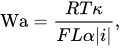
where R is the universal gas constant, T is the operating temperature, κ is the ionic conductivity of the plating solution, F is the Faraday constant, L is the equivalent size of the plated object, α is the transfer coefficient, and i the surface-averaged total (including hydrogen evolution) current density. The Wagner number quantifies the ratio of kinetic to ohmic resistances. A higher Wagner number produces a more uniform deposition. This can be achieved in practice by decreasing the size (L) of the plated object, reducing the current density |i|, adding chemicals that lower α (make the electric current less sensitive to voltage), and raising the solution conductivity (e.g. by adding acid). Concurrent hydrogen evolution usually improves the uniformity of electroplating by increasing |i|; however, this effect can be offset by blockage due to hydrogen bubbles and hydroxide deposits.
The Wagner number is rather difficult to measure accurately; therefore, other related parameters, that are easier to obtain experimentally with standard cells, are usually used instead. These parameters are derived from two ratios: the ratio M = m1 / m2 of the plating thickness of a specified region of the cathode "close" to the anode to the thickness of a region "far" from the cathode and the ratio L = x2 / x1 of the distances of these regions through the electrolyte to the anode. In a Haring-Blum cell, for example, L = 5 for its two independent cathodes, and a cell yielding plating thickness ratio of M = 6 has Harring-Blum throwing power 100% × (L − M) / L = −20%. Other conventions include the Heatley throwing power 100% × (L − M) / (L − 1), Field throwing power 100% × (L − M) / (L + M − 2), and Luke throwing power 100% × L / (L + M − 1). A more uniform thickness is obtained by making the throwing power larger (less negative), except for Luke's throwing power, which has the advantage of having a minimum of 0 and a maximum of 100, in terms of the less negative value, according to any of these definitions.
Parameters that describe cell performance such as throwing power are measured in small test cells of various designs that aim to reproduce conditions similar to those found in the production plating bath.
Haring–Blum cell
The Haring–Blum cell is used to determine the macro throwing power of a plating bath. The cell consists of two parallel cathodes with a fixed anode in the middle. The cathodes are at distances from the anode in the ratio of 1:5. The macro throwing power is calculated from the thickness of plating at the two cathodes when a direct current is passed for a specific period of time. The cell is fabricated out of perspex or glass.
Hull cell
The Hull cell is a type of test cell used to semi-quantitatively check the condition of an electroplating bath. It measures useable current density range, optimization of additive concentration, recognition of impurity effects, and indication of macro throwing power capability. The Hull cell replicates the plating bath on a lab scale. It is filled with a sample of the plating solution and an appropriate anode which is connected to a rectifier. The "work" is replaced with a Hull cell test panel that will be plated to show the "health" of the bath.
The Hull cell is a trapezoidal container that holds 267 milliliters of a plating bath solution. This shape allows one to place the test panel on an angle to the anode. As a result, the deposit is plated at a range current densities along its length, which can be measured with a Hull cell ruler. The solution volume allows for a semi-quantitative measurement of additive concentration: 1 gram addition to 267 mL is equivalent to 0.5 oz/gal in the plating tank.
Effects
Electroplating changes the chemical, physical, and mechanical properties of the workpiece. An example of a chemical change is when nickel plating improves corrosion resistance. An example of a physical change is a change in the outward appearance. An example of a mechanical change is a change in tensile strength or surface hardness, which is a required attribute in the tooling industry. Electroplating of acid gold on underlying copper- or nickel-plated circuits reduces contact resistance as well as surface hardness. Copper-plated areas of mild steel act as a mask if case-hardening of such areas are not desired. Tin-plated steel is chromium-plated to prevent dulling of the surface due to oxidation of tin.
Applications
A distinction is sometimes made between decorative and functional electroplating. The former serves primarily to enhance objects and, for this purpose, must meet certain minimum technical requirements. Examples of decorative electroplating include plastic electroplating, the chrome plating of tubular steel furniture, fittings, and motorcycles, and the gilding of jewelry and cutlery.
Functional electroplating is used for corrosion protection, wear protection, catalysis, improving electrical conductivity, and reducing frictional forces. The ductility and formability of workpieces can also be improved by electroplated coatings. Here are some examples:
Galvanizing of screws (corrosion protection)
Coating of machine parts with hard chrome (wear protection)
Coating with metallic, mostly nickel or platinum-containing catalysts for the chemical industry or fuel cells (catalysis)
Gold and silver plating of electrical contacts (electrical conductivity)
Lead-tin-copper coatings for plain bearings (reducing friction)
Copper plating during wire drawing (improvement of formability)
Rhodium plating of rings and eyeglass frames
Due to their wear resistance and good sliding properties, hard chrome coatings can also be used as coatings for hydraulic cylinders or for lower tubes in suspension forks. The final properties of these components after coating are significantly better than, for example, those of their base materials.
Dental technology
Electroplating can be used in dentistry to produce dental prostheses consisting of thin gold caps veneered with ceramic. Self-supporting metal frameworks made of gold are created using an electrochemical process. In the Auro-Galvano-Crown (AGC) process, a layer of gold approximately 200 µm thick is deposited in the dental laboratory onto tooth stumps prepared with silver powder. The frameworks have a purity of 99.99% gold. Electroplating is suitable for the production of single crowns, denture bases, ceramic-veneered partial crowns and inlays (inlays/onlays), telescopic crowns, dental bridges for tooth replacement, and dental implant superstructures.
Quality assurance
Quality assurance plays a very important role in electroplating. It includes the continuous analysis of bath parameters, such as acid and metal content, monitoring the appearance and color of the coatings, coating thickness measurements using X-ray fluorescence, ultrasound, eddy current methods, and stripping techniques, as well as the inspection of the raw material.
Furthermore, the following can be checked: surface roughness, hardness, adhesion strength and ductility of the layer, surface defects (e.g. pores, cracks) and testing of corrosion resistance using salt spray test, condensation climate, Corrodkote test, CASS test (acetic acid salt solution).
The electrochemical properties of the electrolytes can be assessed by means of practical tests (e.g. Hull cell) or comparative measurements (Haring-Blum cell or cyclic voltammetry).
The quality and final properties of a coating depend, among other things, on the following parameters:
Current density
PH value
Bath temperature
Amount of metal ions in the bath
Degree of contamination of the bath (the stronger the current, the more metal particles in the bath lead to inclusions in the coating)
Duration of galvanizing
Distance between cathode and anode
Degreasing the workpiece
Purity of the water; demineralized water is required to prepare (mix) the bath.
Size ratio between anode and cathode, where the rule of thumb anode: at least twice as large surface area as the cathode is used
Hazards, environmental problems
Other important aspects of electroplating include wastewater treatment and the associated environmental protection, training in the handling of hazardous chemicals, and laboratory work. The thickness of the resulting metal coating varies depending on the application: decorative coatings (e.g., gold or bright chrome) often have thicknesses of less than 1 micrometer (µm), while functional coatings are significantly thicker (zinc or nickel for corrosion protection are approximately 10 µm, hard chrome or nickel for mechanically functional coatings (e.g., in hydraulic cylinders) are usually 100–500 µm).
In electroplating, employees can be exposed to hazardous substances. As part of the risk assessment, the hazardous substances present in the workplace must be identified and appropriate protective measures established. DGUV Information 213-716 of the German Social Accident Insurance (DGUV) specifies procedures and protective measures in electroplating technology to ensure compliance with the workplace exposure limit (OEL) for substances with an OEL. The state of the art is documented for substances without an OEL.
Related procedures
Electrophoretic deposition (dip coating), like electroplating, is a process that uses a direct current to create a coating. However, this coating is non- metallic and is formed by the pH change that occurs during the decomposition of water.
Alternatives to electroplating
There are a number of alternative processes to produce metallic coatings on solid substrates that do not involve electrolytic reduction:
Electroless deposition uses a bath containing metal ions and chemicals that will reduce them to the metal by redox reactions. The reaction should be autocatalytic, so that new metal will be deposited over the growing coating, rather than precipitated as a powder through the whole bath at once. Electroless processes are widely used to deposit nickel-phosphorus or nickel-boron alloys for wear and corrosion resistance, silver for mirror-making, copper for printed circuit boards, and many more. A major advantage of these processes over electroplating is that they can produce coatings of uniform thickness over surfaces of arbitrary shape, even inside holes, and the substrate need not be electrically conducting. Another major benefit is that they do not need power sources or specially-shaped anodes. Disadvantages include lower deposition speed, consumption of relatively expensive chemicals, and a limited choice of coating metals.
Immersion coating processes exploit displacement reactions in which the substrate metal is oxidized to soluble ions while ions of the coating metal get reduced and deposited in its place. This process is limited to very thin coatings, since the reaction stops after the substrate has been completely covered. Nevertheless, it has some important applications, such as the electroless nickel immersion gold (ENIG) process used to obtain gold-plated electrical contacts on printed circuit boards.
Sputtering uses an electron beam or a plasma to eject microscopic particles of the metal onto the substrate in a vacuum.
Physical vapor deposition transfer the metal onto the substrate by evaporating it.
Chemical vapor deposition uses a gas containing a volatile compound of the metal, which gets deposited onto the substrate as a result of a chemical reaction.
Gilding is a traditional way to attach a gold layer onto metals by applying a very thin sheet of gold held in place by an adhesive.
Sourced from Wikipedia

没有评论:
发表评论