The two major parts of the model are its
chromatic adaptation transform, CIECAT02, and its equations for calculating
mathematical correlates for the six technically defined dimensions of color
appearance: brightness (luminance), lightness, colorfulness, chroma, saturation,
and hue.
Brightness is the subjective appearance of
how bright an object appears given its surroundings and how it is illuminated.
Lightness is the subjective appearance of how light a color appears to be.
Colorfulness is the degree of difference between a color and grey. Chroma is
the colorfulness relative to the brightness of another color that appears white
under similar viewing conditions. This allows for the fact that a surface of a
given chroma displays increasing colorfulness as the level of illumination
increases. Saturation is the colorfulness of a color relative to its own
brightness. Hue
CIECAM02 takes for its input the
tristimulus values of the stimulus, the tristimulus values of an adapting white
point, adapting background, and surround luminance information, and whether or
not observers are discounting the illuminant (color constancy is in effect).
The model can be used to predict these appearance attributes or, with forward
and reverse implementations for distinct viewing conditions, to compute
corresponding colors.
CIECAM02 is used in Windows Vista's Windows
Color System.
Viewing conditions
The inner circle is the stimulus, from
which the tristimulus values should be measured in CIE XYZ using the 2°
standard observer. The intermediate circle is the proximal field, extending out
another 2°. The outer circle is the background, reaching out to 10°, from which
the relative luminance (Yb) need be measured. If the proximal field is the same
color as the background, the background is considered to be adjacent to the
stimulus. Beyond the circles which comprise the display field (display area,
viewing area) is the surround field (or peripheral area), which can be
considered to be the entire room. The totality of the proximal field,
background, and surround is called the adapting field (the field of view that
supports adaptation—extends to the limit of vision).
When referring to the literature, it is
also useful to be aware of the difference between the terms adopted white point
(the computational white point) and the adapted white point (the observer white
point). The distinction may be important in mixed mode illumination, where
psychophysical phenomena come into play. This is a subject of research.
Parameter decision table
CIECAM02 defines three surround(ing)s –
average, dim, and dark – with associated parameters defined here for reference
in the rest of this article:
Surround
conditionSurround
ratioFcNcApplicationAverageSR > 0.21.00.691.0Viewing surface colorsDim0 < SR < 0.20.90.590.95Viewing televisionDarkSR = 00.80.5250.8Using a projector in a dark room
R = Lsw / Ldw: ratio of the absolute
luminance of the reference white (white point) measured in the surround field
to the display area. The 0.2 coefficient derives from the "gray
world" assumption (~18%–20% reflectivity). It tests whether the surround
luminance is darker or brighter than medium gray.
F: factor determining degree of adaptation
c: impact of surrounding
Nc: chromatic induction factor
For intermediate conditions, these values
can be linearly interpolated.
The absolute luminance of the adapting
field, which is a quantity that will be needed later, should be measured with a
photometer. If one is not available, it can be calculated using a reference
white:
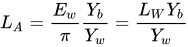
where Yb is the relative luminance of
background, the Ew = πLW is the illuminance of the reference white in lux, LW
is the absolute luminance of the reference white in cd/m2, and Yw is the
relative luminance of the reference white in the adapting field. If unknown,
the adapting field can be assumed to have average reflectance ("gray
world" assumption): LA = LW / 5.
Note: Care should be taken not to confuse
LW, the absolute luminance of the reference white in cd/m2, and Lw the red cone
response in the LMS color space.
Chromatic adaptation
Summary
Convert to the "spectrally
sharpened" CAT02 LMS space to prepare for adaptation. Spectral sharpening
is the transformation of the tristimulus values into new values that would have
resulted from a sharper, more concentrated set of spectral sensitivities. It is
argued that this aids color constancy, especially in the blue region.(Compare
Finlayson et al. 94, Spectral Sharpening:Sensor Transformations for Improved
Colour Constancy)
Perform chromatic adaptation using CAT02
(also known as the "modified CMCCAT2000 transform").
Convert to an LMS space closer to the cone
fundamentals. It is argued that predicting perceptual attribute correlates is
best done in such spaces.
Perform post-adaptation cone response
compression.
CAT02
Given a set of tristimulus values in XYZ,
the corresponding LMS values can be determined by the MCAT02 transformation
matrix (calculated using the CIE 1931 2° standard colorimetric observer). The
sample color in the test illuminant is:

Once in LMS, the white point can be adapted
to the desired degree by choosing the parameter D. For the general CAT02, the
corresponding color in the reference illuminant is:
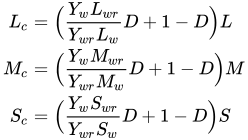
where the Yw / Ywr factor accounts for the
two illuminants having the same chromaticity but different reference whites.
The subscripts indicate the cone response for white under the test (w) and
reference illuminant (wr). The degree of adaptation (discounting) D can be set
to zero for no adaptation (stimulus is considered self-luminous) and unity for
complete adaptation (color constancy). In practice, it ranges from 0.65 to 1.0,
as can be seen from the diagram. Intermediate values can be calculated by:

where surround F is as defined above and LA
is the adapting field luminance in cd/m2.
In CIECAM02, the reference illuminant has
equal energy Lwr = Mwr = Swr = 100) and the reference white is the perfect reflecting
diffuser (i.e., unity reflectance, and Ywr = 100) hence:
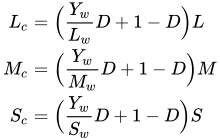
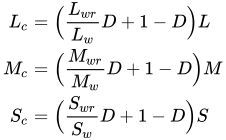
Furthermore, if the reference white in both
illuminants have the Y tristimulus value (Ywr = Yw) then:
Post-adaptation
After adaptation, the cone responses are
converted to the Hunt–Pointer–Estévez space by going to XYZ and back:

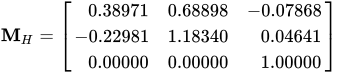
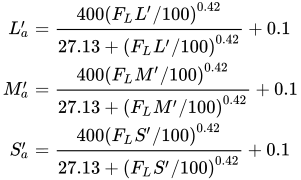
Finally, the response is compressed based
on the generalized Michaelis–Menten equation (as depicted aside):
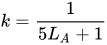

FL is the luminance level adaptation
factor.
As previously mentioned, if the luminance
level of the background is unknown, it can be estimated from the absolute
luminance of the white point as LA = LW / 5 using the "medium gray"
assumption. (The expression for FL is given in terms of 5LA for convenience.)
In photopic conditions, the luminance level adaptation factor (FL) is
proportional to the cube root of the luminance of the adapting field (LA). In
scotopic conditions, it is proportional to LA (meaning no luminance level
adaptation). The photopic threshold is roughly LW = 1 (see FL–LA graph above).
Appearance correlates
CIECAM02 defines correlates for
yellow-blue, red-green, brightness, and colorfulness. Let us make some
preliminary definitions.
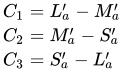
The correlate for red–green (a) is the
magnitude of the departure of C1 from the criterion for unique yellow (C1 = C2
/ 11), and the correlate for yellow–blue (b) is based on the mean of the
magnitude of the departures of C1 from unique red (C1 = C2) and unique green
(C1 = C3).

The 4.5 factor accounts for the fact that
there are fewer cones at shorter wavelengths (the eye is less sensitive to
blue). The order of the terms is such that b is positive for yellowish colors
(rather than blueish).
The hue angle (h) can be found by
converting the rectangular coordinate (a, b) into polar coordinates:

To calculate the eccentricity (et) and hue
composition (H), determine which quadrant the hue is in with the aid of the
following table. Choose i such that hi ≤ h′ < hi+1,
where h′ = h if h
> h1 and h′ = h + 360° otherwise.
RedYellowGreenBlueRedi12345hi20.1490.00164.25237.53380.14ei0.80.71.01.20.8Hi0.0100.0200.0300.0400.0
![{\begin{aligned}H&=H_{i}+{\frac {100(h^{\prime }-h_{i})/e_{i}}{(h^{\prime }-h_{i})/e_{i}+(h_{{i+1}}-h^{\prime })/e_{{i+1}}}}\\e_{t}&=\textstyle {{\frac {1}{4}}}\left[\cos \left(\textstyle {{\frac {\pi }{180}}}h+2\right)+3.8\right]\end{aligned}}](https://wikimedia.org/api/rest_v1/media/math/render/svg/217dd8e23d8ee620bba575abff3f00a6be44af5b)
(This is not exactly the same as the
eccentricity factor given in the table.)
Calculate the achromatic response A:

where
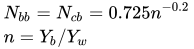
The correlate of lightness is

where c is the impact of surround (see
above), and
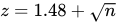
The correlate of brightness is

Then calculate a temporary quantity t,
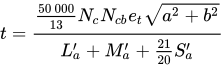
The correlate of chroma is

The correlate of colorfulness is
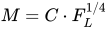
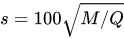
The correlate of saturation is
Source From Wikipedia


没有评论:
发表评论